Cat7 and Cat8 Cables: What They Are and Who Needs Them
Cat7 is ISO-only with GG45 or TERA connectors; Cat8 is a 30 m data-centre cable. Learn what each standard says and what to buy for home or office.
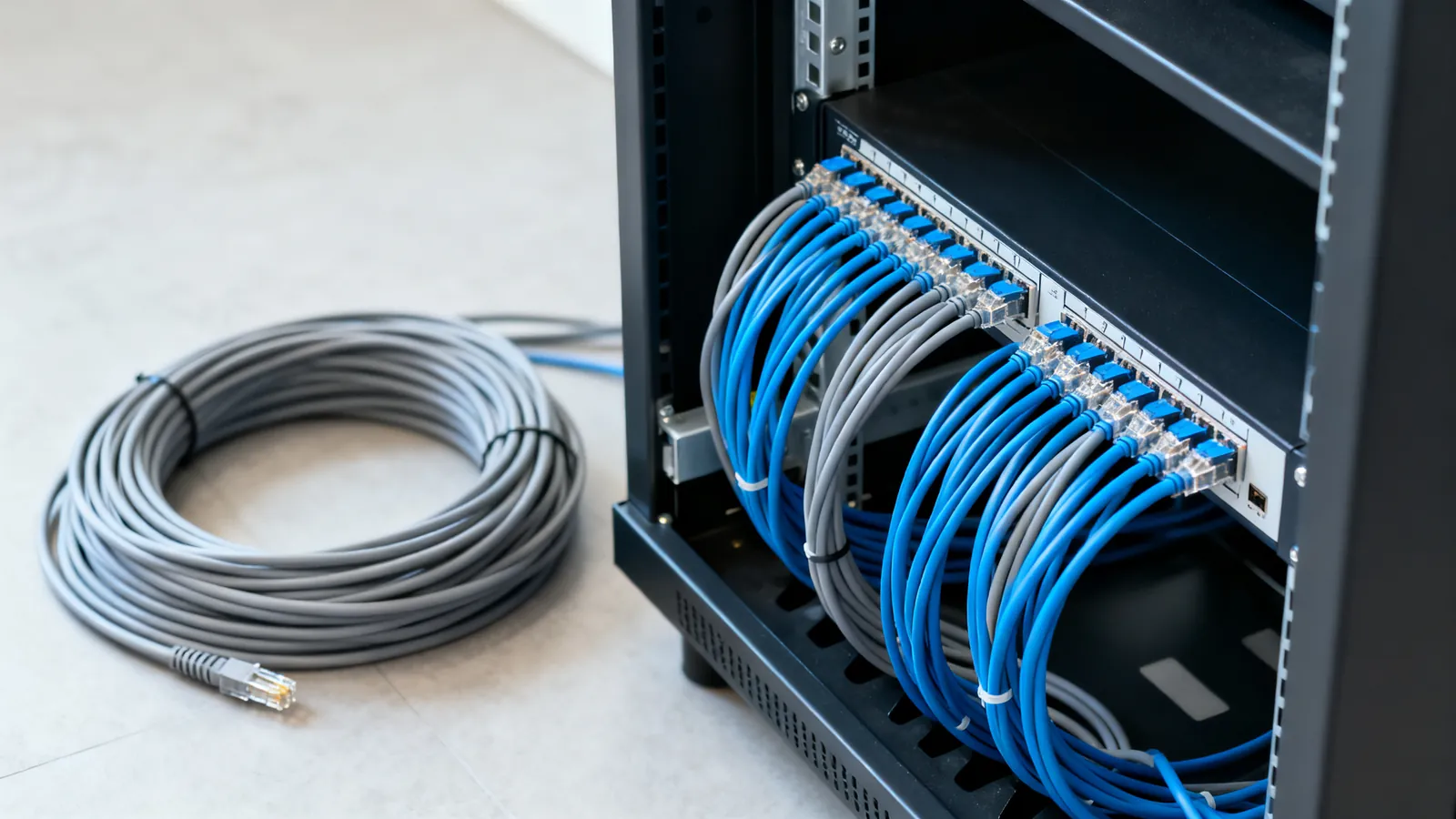
Cat7 and Cat8 are the two highest-numbered twisted-pair Ethernet categories, and both are widely misunderstood. Cat7 is an ISO/IEC category that is not part of the TIA-568 system used in North America, and its standard connectors are not RJ45. Cat8 is a TIA category built for a specific job: 25GBASE-T and 40GBASE-T switch-to-server links inside data centres, on a channel of up to 30 m (98 ft) with two connectors. For a home or a small office, neither is usually the right purchase. A Cat6 or Cat6a cable does everything a domestic or office network needs, and it does it with standard RJ45 connectors and a 100 m (328 ft) channel.
What Cat7 actually is
Cat7 is defined in ISO/IEC 11801 as Class F. It is rated to 600 MHz, and every pair is individually shielded, giving an S/FTP construction: an overall braid plus foil around each pair. That shielding is what allows the higher frequency rating.
The catch is the connector. The standard’s own connectors for Cat7 are GG45 and TERA, neither of which is an RJ45 plug. A patch cord sold as “Cat7” with RJ45 plugs on the ends is not a standard Cat7 channel. It performs as the RJ45 connection allows, which is the same limitation any other RJ45 cable has. The cable may be well made, but the category label does not describe a standards-compliant end-to-end link.
Cat7A (Class FA) goes further, rated to 1000 MHz. It is also an ISO-only category, and it has the same connector issue.
Is Cat7 worth it?
For most installations, no. The extra shielding only helps if the whole channel is shielded and grounded: shielded jacks, shielded plugs, shielded patch panels, and grounding through the equipment. A shield that is broken or not grounded gives no benefit and can pick up noise. In a home or ordinary office, where cable runs are short and the environment is not electrically hostile, the shielding has nothing to do. The money is better spent on solid copper Cat6 or Cat6a and on doing the terminations properly.
What Cat8 actually is
Cat8 is a TIA category, defined in TIA-568.2-D. It is rated to 2000 MHz and supports 25GBASE-T (25 Gbps) and 40GBASE-T (40 Gbps) on a channel of up to 30 m (98 ft) with two connectors. That short channel is the point: Cat8 is meant for switch-to-server links inside data centres, where equipment is close together and the speed is high.
There are two variants. Cat8.1 uses RJ45 connectors. Cat8.2 uses non-RJ45 connectors. Both are limited to the same 30 m channel.
Cat8 for home
Cat8 for a home network is almost always the wrong choice. A home run is typically far longer than 30 m, and the speeds a home network uses are far below 25 Gbps. The 30 m limit applies to the channel, not just the cable in the wall, so patch cords count against it. A Cat8 cable run to a distant room will not deliver 25GBASE-T or 40GBASE-T, and for 1 Gbps or 10 Gbps it offers nothing over Cat6a. The stiff, heavily shielded construction is also harder to terminate and to route around tight bends.
Cat7 vs Cat8 vs Cat6a: the numbers
| Category | Standard | Rated frequency | 10GBASE-T reach | Higher speeds | Connectors |
|---|---|---|---|---|---|
| Cat6 | TIA-568 | 250 MHz | 55 m (180 ft), as little as 37 m (121 ft) bundled | — | RJ45 |
| Cat6a | TIA-568 | 500 MHz | 100 m (328 ft) | — | RJ45 |
| Cat7 | ISO/IEC Class F | 600 MHz | 100 m (328 ft) as a channel | — | GG45, TERA (standard); RJ45 cords are not standard Cat7 |
| Cat7A | ISO/IEC Class FA | 1000 MHz | 100 m (328 ft) as a channel | — | GG45, TERA |
| Cat8 | TIA-568.2-D | 2000 MHz | — | 25GBASE-T and 40GBASE-T to 30 m (98 ft), two connectors | Cat8.1 RJ45; Cat8.2 non-RJ45 |
Cat6a is the practical ceiling for a building-wide copper installation. It carries 10 Gbps to the full 100 m (328 ft) channel, uses ordinary RJ45 connectors, and is available in solid copper for horizontal runs. For a comparison of the categories below it, see Ethernet cable categories explained: Cat5e to Cat8.
The 100 m channel and why it matters
The 100 m (328 ft) limit is not a cable property; it is a channel property. The channel is made of up to 90 m (295 ft) of permanent link (the horizontal cable in the wall) plus up to 10 m (33 ft) of patch and equipment cords. The limit applies to every speed from 10 Mbps to 10 Gbps on the matching category, and it is set by signal loss and timing.
Cat8 changes that arithmetic. Its 30 m (98 ft) channel includes the patch cords, so a Cat8 run in a building is short by design. If a run needs to cross a floor or reach the far end of a house, Cat8 is not the cable for it.
What to buy instead
For a home or small office, the choice is between Cat5e, Cat6 and Cat6a. Cat5e carries 1000BASE-T (1 Gbps) to 100 m and 2.5GBASE-T (2.5 Gbps) to 100 m under IEEE 802.3bz. Cat6 carries 1 Gbps to 100 m and 10GBASE-T up to 55 m (180 ft), and as little as 37 m (121 ft) where many cables run bundled together. Cat6a carries 10 Gbps to the full 100 m.
If the plan is 10 Gbps to every outlet, Cat6a is the safe choice. If the plan is 1 Gbps or 2.5 Gbps, Cat5e or Cat6 is enough. For a direct comparison, see Cat5e vs Cat6 vs Cat6a: which one to buy.
Whatever the category, the conductor matters more than the label. Category cable is solid or stranded copper. Copper-clad aluminium (CCA) conductors do not meet TIA category standards: higher resistance, brittle when flexed, more heat under PoE. For horizontal runs, use solid copper; for patch cords that flex, stranded copper. Cat5e is commonly 24 AWG, Cat6 23 or 24 AWG, Cat6a 23 AWG; patch cords 24 to 26 AWG; slim patch cords 28 AWG (permitted for patch cords by TIA-568.2-D).
What goes wrong
The Cat7 label on an RJ45 cord. A patch cord with RJ45 plugs cannot be a standard Cat7 channel. The cable may be shielded and well made, but the connection is an RJ45 connection, and the link performs as one. Paying a premium for the label buys nothing measurable.
Shielding without grounding. A shielded system needs shielded jacks, plugs and patch panels, and grounding through the equipment. A shield that is broken or not grounded gives no benefit and can pick up noise. This is the most common failure in installations that use shielded cable with unshielded patch panels or ungrounded equipment.
Cat8 over a long run. Cat8’s 25GBASE-T and 40GBASE-T reach is 30 m (98 ft) with two connectors. A longer run will not deliver those speeds, and for 1 Gbps or 10 Gbps the cable offers nothing over Cat6a. Cat8 is a data-centre cable, not a whole-building cable.
CCA cable. Copper-clad aluminium does not meet TIA category standards. It has higher resistance, is brittle when flexed, and runs hotter under PoE. It should never carry PoE.
Untwisted pairs at the termination. The pair untwist at a termination should be no more than 13 mm (0.5 in) for Cat5e and higher (TIA-568). More than that degrades the link, especially at higher frequencies.
Bend radius and pulling tension. Installed bend radius for 4-pair UTP is at least 4 times the cable’s outside diameter. Maximum pulling tension for 4-pair cable is 25 lbf (110 N). Shielded cables are stiffer and less forgiving of both.
Separation from mains. The NEC asks for at least 50 mm (2 in) between communications cable and mains power conductors unless a barrier separates them; cross power cables at a right angle. Mains work is a job for a licensed electrician.
Testing. A continuity or wiremap tester finds opens, shorts, crossed wires and reversed pairs, but split pairs pass a simple continuity test and need a tester that measures crosstalk. Only a certification tester can prove a link meets Cat6 or Cat6a limits. A TDR shows the distance to a fault.
The short answer
Cat7 is an ISO-only category with GG45 or TERA connectors; an RJ45 Cat7 patch cord is not a standard Cat7 channel. Cat8 is a TIA category for 25GBASE-T and 40GBASE-T over a 30 m (98 ft) channel with two connectors, meant for switch-to-server links inside data centres. For a home or office, Cat6 or Cat6a on solid copper, terminated to TIA-568, is the right choice. If the run is long and the speed is high, the answer is fiber, not a higher-numbered copper category.
Common questions
Is Cat7 worth it for a home network?
Usually not. Cat7 is an ISO-only category with GG45 or TERA connectors, and an RJ45 Cat7 patch cord is not a standard Cat7 channel. The shielding only helps if the whole channel is shielded and grounded. For a home, Cat6 or Cat6a on solid copper is the better buy.
Can I use Cat8 for a long Ethernet run?
No. Cat8 supports 25GBASE-T and 40GBASE-T on a channel of up to 30 m (98 ft) with two connectors. A longer run will not deliver those speeds, and for 1 Gbps or 10 Gbps it offers nothing over Cat6a.
What is the difference between Cat7 and Cat6a?
Cat6a is a TIA category rated to 500 MHz and carries 10 Gbps to the full 100 m (328 ft) channel using RJ45 connectors. Cat7 is an ISO/IEC Class F category rated to 600 MHz with individually shielded pairs, and its standard connectors are GG45 and TERA, not RJ45.
Does Cat8 work with RJ45 connectors?
Cat8.1 uses RJ45 connectors; Cat8.2 uses non-RJ45 connectors. Both are limited to a 30 m (98 ft) channel with two connectors.
What should I buy instead of Cat7 or Cat8?
For a home or small office, Cat6a carries 10 Gbps to 100 m (328 ft) on standard RJ45 connectors. Cat6 carries 1 Gbps to 100 m and 10 Gbps up to 55 m (180 ft). Use solid copper for horizontal runs and stranded copper for patch cords.
Read next
Cat5e vs Cat6 vs Cat6a: Which Ethernet Cable to Buy
Cat5e, Cat6 and Cat6a compared: bandwidth, 10 Gbps reach, shielding and when each category is the right choice for home or office cabling.
Ethernet Cable Categories: Cat5e to Cat8
Ethernet cable categories compared: Cat5e, Cat6, Cat6a, Cat7 and Cat8 rated frequency, speed and distance, plus which to buy for home, office and 10 Gbps.
Fiber Connector Types: LC, SC, ST, MPO, UPC vs APC
Compare LC, SC, ST and MPO fiber connectors, and learn why UPC and APC polish must never be mated. Includes cleaning and selection advice.