Fiber Connector Types: LC, SC, ST, MPO, UPC vs APC
Compare LC, SC, ST and MPO fiber connectors, and learn why UPC and APC polish must never be mated. Includes cleaning and selection advice.
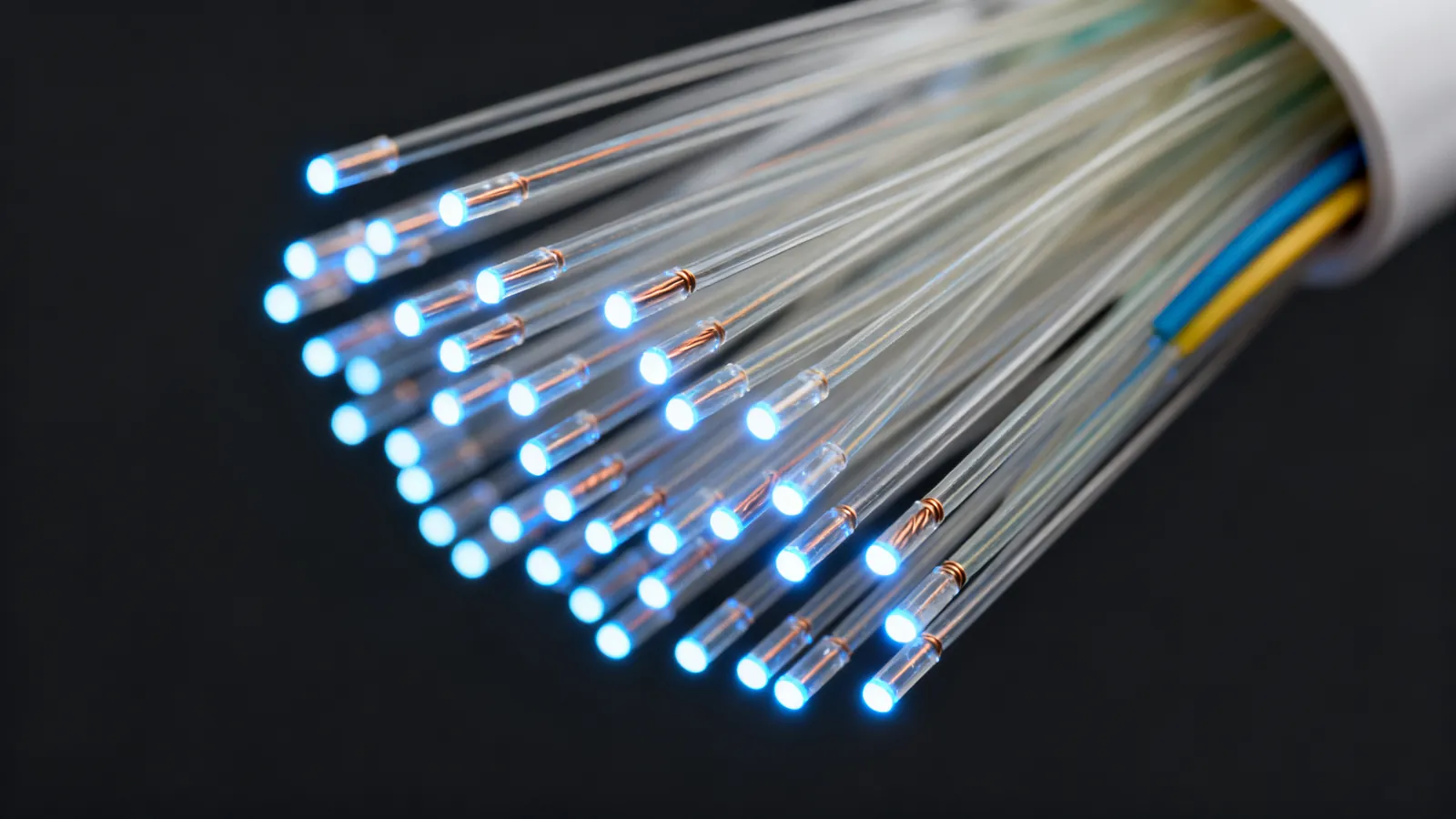
Fiber connectors join two fibers so light passes from one to the other with as little loss as possible. The four you will meet are LC, SC, ST and MPO. LC is the small square connector used on SFP modules; SC is the larger square push-pull type; ST is the older twist-lock bayonet; MPO holds 12 or 24 fibers in one ferrule for 40G and 100G parallel optics. The other half of the choice is polish: UPC (blue body) and APC (green body, 8 degrees angled end face). An APC connector must never be mated with a UPC one.
LC, SC, ST and MPO: what each one is
LC (Lucent Connector)
LC uses a 1.25 mm ferrule and a small square plastic body with a latch. It is the usual connector on SFP, SFP+, SFP28, QSFP+ and QSFP28 modules, and on patch panels and fiber patch cords in data centres and enterprise networks. Because it is small, a duplex LC pair fits the pitch of an SFP port. You will see it written as LC/UPC or LC/APC.
SC (Subscriber Connector)
SC uses a 2.5 mm ferrule and a square push-pull body. It clicks into place and releases with a pull on the body, not a latch. SC is common on older patch panels, on many singlemode links, and on passive optical network (PON) equipment. It is roughly twice the size of LC.
ST (Straight Tip)
ST uses a 2.5 mm ferrule and a twist-lock bayonet coupling, like a BNC. It was the standard connector on early multimode networks and is still found on legacy equipment, industrial gear and some test sets. ST is not used on new SFP ports; if you are patching into an ST patch panel, you need an ST to LC or ST to SC patch cord.
MPO / MTP
MPO (Multi-fiber Push On) puts 12 or 24 fibers in one rectangular ferrule. It is used for 40GBASE-SR4 and 100GBASE-SR4 parallel optics, where four or ten lanes run side by side. MTP is a brand name for a high-performance MPO variant. MPO cables are usually trunk cables between cassettes or breakout modules that fan out to LC duplex pairs.
| Connector | Ferrule | Coupling | Typical use |
|---|---|---|---|
| LC | 1.25 mm | Latch | SFP/SFP+/QSFP modules, patch panels |
| SC | 2.5 mm | Push-pull | Older panels, PON, singlemode |
| ST | 2.5 mm | Twist-lock bayonet | Legacy multimode, industrial |
| MPO/MTP | 12 or 24 fibers | Push-on | 40G/100G parallel optics |
UPC vs APC: the polish that must not be mixed
UPC (Ultra Physical Contact) has a domed, perpendicular end face. The connector body is usually blue. APC (Angled Physical Contact) has an end face polished at an 8-degree angle; the body is green. The angle reduces back reflection, which matters on singlemode links, especially analog video and RF over fiber.
An APC connector must never be mated with a UPC one. The angled face and the flat face do not meet; the link either fails or the two end faces are damaged. If you have an APC patch panel, use APC patch cords throughout. If you have UPC, use UPC. The colour is the quick check: blue to blue, green to green.
APC is common on singlemode outside plant and FTTH. UPC is the default on multimode and on most short singlemode links inside a building.
Singlemode and multimode: which fiber goes with which connector
The connector does not care whether the fiber is singlemode or multimode; the cable and the transceiver do. Singlemode is 9 µm core, 125 µm cladding, used at 1310 nm and 1550 nm, with yellow jacket. Multimode is 50 µm or 62.5 µm core, 125 µm cladding, used at 850 nm (and 1300 nm), with orange, aqua, violet or lime green jacket depending on grade. For the full grade list, see fiber optic cable types.
Reach depends on the transceiver and the fiber grade, not the connector. 10GBASE-SR reaches 33 m on OM1, 82 m on OM2, 300 m (984 ft) on OM3 and 400 m (1312 ft) on OM4 and OM5. 1000BASE-SX reaches 275 m (902 ft) on OM1 and 550 m (1804 ft) on OM2. 40GBASE-SR4 reaches 100 m on OM3 and 150 m on OM4; 100GBASE-SR4 reaches 70 m on OM3 and 100 m on OM4. On singlemode, 10GBASE-LR reaches 10 km (about 6 miles) and 10GBASE-ER reaches 40 km.
Which connector for which port
SFP, SFP+, SFP28, QSFP+ and QSFP28 ports take LC. SFP is 1 Gbps, SFP+ is 10 Gbps, SFP28 is 25 Gbps, QSFP+ is 40 Gbps and QSFP28 is 100 Gbps. For short runs between racks, a DAC (direct attach copper) cable joins two SFP ports without separate optics; passive SFP+ DAC cables run up to 7 m. AOC (active optical cable) is a fixed fiber cable with transceivers built in, for longer runs. 10GBASE-T SFP+ copper modules typically reach 30 m on Cat6a. See SFP transceivers and DAC cables for the module side of the link.
MPO is for 40G and 100G parallel optics. A 40GBASE-SR4 link uses an 8-fiber MPO (four transmit, four receive); 100GBASE-SR4 uses a 24-fiber or 12-fiber MPO depending on the module. Polarity matters: MPO trunks are wired Type A, B or C, and the cassette or breakout must match. If you are not sure, buy pre-terminated cassettes and patch cords as a set.
Cleaning before you connect
Every fiber connector should be cleaned and inspected before it is mated. A speck of dust on a 9 µm core blocks light and can scratch the end face. Use a one-click cleaner for LC and SC, or lint-free wipes with optical-grade isopropyl alcohol for exposed ferrules. Dry the end face before mating. Inspect with a fiber scope if you have one; if you do not, clean anyway. Never touch the ferrule tip with a finger.
Dust caps protect the end face in transit; put them back on unused ports and patch cords. A dirty connector can also damage the mating connector, so clean both sides.
What goes wrong
- Mating APC with UPC. The angled face and the flat face do not meet. The link fails or the connectors are damaged. Match green to green and blue to blue.
- Using the wrong polish on a singlemode link. APC is used where back reflection matters; UPC is the default elsewhere. Do not mix them in one channel.
- Dirty end faces. A single speck of dust causes high loss or permanent scratches. Clean and inspect before every mate.
- Wrong MPO polarity. Type A, B and C trunks are wired differently. A mismatch gives no link or swapped transmit and receive.
- Forcing a connector. LC and SC click or slide in; ST twists. If it does not seat easily, stop and check the key orientation.
- Bending fiber too tightly. Bend radius matters; a sharp bend causes loss or a crack. Follow the cable’s minimum bend radius.
- Assuming the connector sets the speed. The transceiver and fiber grade set the speed and reach. An LC connector on OM1 will not make a 10GBASE-SR link reach 300 m.
Choosing in practice
For new SFP-based equipment, use LC. For an existing SC or ST patch panel, use a patch cord with the matching connector on one end and LC on the other. For 40G or 100G parallel optics, use MPO with the correct polarity and fiber count. For singlemode outside plant or FTTH, use APC (green) if the system is APC; otherwise UPC (blue). When in doubt, match what is already in the panel and clean before you connect.
Common questions
What is the difference between LC and SC fiber connectors?
LC uses a 1.25 mm ferrule and a small latch, and is the usual connector on SFP modules. SC uses a 2.5 mm ferrule and a square push-pull body, common on older patch panels and PON equipment. LC is roughly half the size of SC.
Can I connect a UPC cable to an APC port?
No. The APC end face is polished at an 8-degree angle and the UPC face is flat, so they do not meet properly. The link will fail or the connectors will be damaged. Match blue (UPC) to blue and green (APC) to green.
What is an MPO connector used for?
MPO holds 12 or 24 fibers in one ferrule and is used for 40GBASE-SR4 and 100GBASE-SR4 parallel optics. It is common in trunk cables and breakout cassettes that fan out to LC duplex pairs.
Do I need to clean new fiber connectors?
Yes. New connectors can carry dust from packaging or manufacturing. Clean and inspect every end face before mating; a single speck on a 9 µm core causes high loss or scratches.
Is ST still used?
ST is a legacy twist-lock connector found on older multimode networks, industrial gear and some test equipment. It is not used on new SFP ports, but ST to LC patch cords are available for patching into existing ST panels.
Read next
Fiber Optic Cable Types: Singlemode and Multimode
Singlemode and multimode fiber compared: OS2, OM1 to OM5, jacket colours, reach at 1G, 10G, 40G and 100G, and how to choose for a building or campus.
Multimode Fiber Grades Compared: OM1 to OM5
Compare OM1 to OM5 multimode fiber: core size, jacket colour, and 1G, 10G, 40G and 100G reach. See what to install new and what old OM1 and OM2 still carry.
SFP vs SFP+: Modules, DAC and AOC Cables
SFP vs SFP+: how the module family scales from 1G to 100G, which fiber each type needs, when to use DAC or AOC cables, and why vendor coding matters.