SFP vs SFP+: Modules, DAC and AOC Cables
SFP vs SFP+: how the module family scales from 1G to 100G, which fiber each type needs, when to use DAC or AOC cables, and why vendor coding matters.
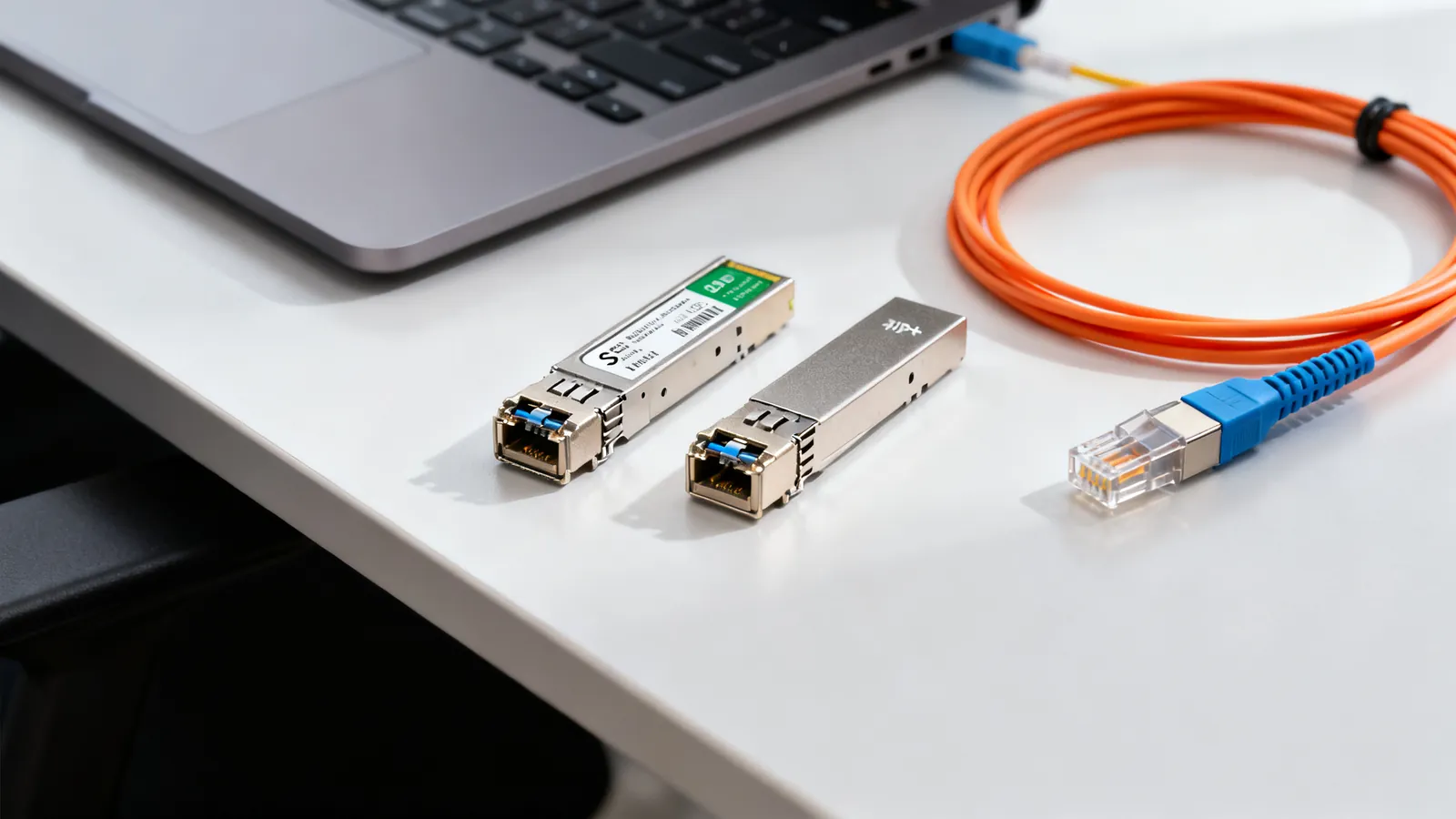
SFP and SFP+ are pluggable transceiver modules that let one switch port accept different kinds of cabling. The short answer: SFP runs at 1 Gbps, SFP+ runs at 10 Gbps, and the two look identical but are not interchangeable in every port. The letter after SFP tells you the speed, not the cable. What the module plugs into — fiber, twinax copper or an active optical cable — is a separate decision.
The module family by speed
Each generation of module keeps roughly the same physical size and adds speed. The port on the switch, not the module, decides what it will accept.
| Module | Speed | Typical use |
|---|---|---|
| SFP | 1 Gbps | Access ports, legacy uplinks |
| SFP+ | 10 Gbps | Server and switch uplinks |
| SFP28 | 25 Gbps | Top-of-rack server links |
| QSFP+ | 40 Gbps | Four-lane uplinks |
| QSFP28 | 100 Gbps | Core and spine links |
SFP and SFP+ share the same cage and connector, so an SFP+ port usually accepts an SFP module at 1 Gbps, but an SFP-only port will not run an SFP+ module at 10 Gbps. SFP28 is the same idea at 25 Gbps and is backward compatible with SFP+ in many ports. QSFP and QSFP28 are wider modules that carry four lanes at once.
Matching a module to the fiber
The module’s optics decide the fiber. Singlemode and multimode are not interchangeable, and the wavelength printed on the module has to match the fiber grade.
Singlemode is 9 µm core and 125 µm cladding, used at 1310 nm and 1550 nm, with yellow jackets. Multimode is 50 µm or 62.5 µm core and 125 µm cladding, used at 850 nm, with orange, aqua or lime green jackets depending on grade. A 10GBASE-SR module is multimode at 850 nm; a 10GBASE-LR module is singlemode at 1310 nm. Plugging a singlemode module into multimode fiber, or the reverse, gives no link at all.
Reach depends on both the module and the fiber grade. For 10GBASE-SR, OM1 reaches 33 m, OM2 82 m, OM3 300 m (984 ft), OM4 400 m (1312 ft) and OM5 400 m. For 1000BASE-SX, OM1 reaches 275 m (902 ft) and OM2 550 m (1804 ft). 40GBASE-SR4 reaches 100 m on OM3 and 150 m on OM4; 100GBASE-SR4 reaches 70 m on OM3 and 100 m on OM4. On singlemode, 10GBASE-LR reaches 10 km (about 6 miles) and 10GBASE-ER reaches 40 km.
If the fiber grade is unknown, OM1, OM2, OM3, OM4 and OM5 multimode fiber compared explains how jacket colour and core size identify it. For a wider view of when fiber is the right medium at all, fiber vs copper Ethernet: when fiber makes sense covers the trade-offs.
Connectors and polish
SFP and SFP+ modules almost always use LC connectors — 1.25 mm ferrule, small, duplex clip. SC (2.5 mm ferrule, push-pull) and ST (2.5 mm ferrule, twist-lock bayonet) appear on older patch panels and media converters. QSFP and QSFP28 use MPO/MTP, which puts 12 or 24 fibers in one ferrule for parallel optics.
Polish matters. UPC connectors have a blue body and a flat end face; APC connectors have a green body and an 8-degree angled end face. Never mate an APC connector with a UPC one — the faces do not meet and the link fails or the connectors are damaged. Most SFP and SFP+ links are UPC.
DAC and AOC for short links
Not every link needs separate transceivers and patch cords. For short runs inside a rack or between adjacent racks, two pre-terminated options replace the module-plus-fiber pair.
A DAC cable — direct attach copper, also called a twinax cable — is a fixed assembly with SFP-style modules on both ends and twinax copper in between. Passive SFP+ DAC cables run up to 7 m. They are the usual choice for switch-to-switch and switch-to-server links within a rack because they cost less than two optics and a patch cord, and they draw almost no power.
An AOC cable — active optical cable — is a fixed fiber cable with transceivers built into each end. It goes further than DAC and is immune to electrical interference, which suits runs between racks or across a noisy floor. Both DAC and AOC are directional in many cases: the end marked for the switch or host must go to that device.
| Cable | Medium | Typical reach | Best for |
|---|---|---|---|
| Passive SFP+ DAC | Twinax copper | Up to 7 m | In-rack links |
| AOC | Fiber with built-in optics | Longer runs | Between racks |
| 10GBASE-SR module + OM4 | Multimode fiber | 400 m (1312 ft) | Building backbone |
| 10GBASE-LR module + singlemode | Singlemode fiber | 10 km | Campus and long runs |
Copper SFP+ modules
A copper SFP+ module is an RJ45 port in an SFP+ cage. It lets a 10GBASE-T link run from an SFP+ slot, typically reaching 30 m on Cat6a. These modules run warmer and draw more power than fiber optics, and they are not the right answer for long runs — they exist to connect an SFP+ port to an existing copper patch panel or a 10GBASE-T switch port.
SFP28 vs SFP+
SFP28 is the 25 Gbps member of the same family. It uses the same cage and the same LC fiber as SFP+, and a 25GBASE-SR module reaches 70 m on OM3 and 100 m on OM4. The practical difference is the switch port: an SFP28 port often accepts SFP+ and SFP modules at their own speeds, but an SFP+ port will not run an SFP28 module at 25 Gbps. When buying, match the module to the port’s rated speed, not to the connector shape.
What goes wrong
- Mismatched fiber type. A singlemode module on multimode fiber, or the reverse, gives no link. Check the wavelength on the module against the fiber grade.
- APC mated to UPC. The angled and flat end faces do not meet. The link fails, and the connectors can be damaged. Match green to green and blue to blue.
- Vendor coding. Switch vendors may accept only modules coded for their equipment. A compatible module is coded for a specific vendor; an uncoded or wrongly coded module may be rejected by the switch even though the optics are fine.
- DAC length. Passive SFP+ DAC cables run up to 7 m. Beyond that, use AOC or a module-and-fiber link.
- Copper SFP+ expectations. A 10GBASE-T SFP+ module typically reaches 30 m on Cat6a, not 100 m. It is a short-reach adapter, not a replacement for a fiber uplink.
- Dirty or scratched ferrules. Fiber end faces must be clean. A speck of dust on an LC ferrule blocks the link or raises loss until it fails intermittently.
- Bend radius. Fiber has a minimum bend radius. Tight coils behind a patch panel can break the fiber or raise loss.
Choosing the right module and cable
Start with the port speed. A 1 Gbps port takes an SFP module; a 10 Gbps port takes SFP+; a 25 Gbps port takes SFP28. Then measure the run. In-rack links under 7 m are usually passive DAC. Runs between racks are AOC or a module with multimode fiber. Building backbones and campus links are singlemode with LR or ER modules.
For the fiber itself, fiber optic cable types: singlemode, multimode and OM grades sets out the core sizes, jacket colours and grades in one place. Buy factory-terminated patch cords with the correct connector and polish, keep spare modules of each type on hand, and label both ends. Fiber carries no electricity, so it is immune to electrical interference and to ground-potential differences between buildings — one reason it is the default for links that leave a rack or a building.
Common questions
Can I use an SFP module in an SFP+ port?
Yes, in most switches. An SFP+ port usually accepts an SFP module and runs it at 1 Gbps. The reverse does not work: an SFP-only port will not run an SFP+ module at 10 Gbps.
What is the difference between a DAC cable and an AOC cable?
A DAC cable is direct attach copper, also called twinax, with modules fixed on both ends; passive SFP+ DAC runs up to 7 m. An AOC cable is a fixed fiber cable with transceivers built in, for longer runs. Both replace a separate module and patch cord.
What is SFP28 vs SFP+?
SFP28 is the 25 Gbps member of the family; SFP+ is 10 Gbps. They use the same cage and LC fiber. An SFP28 port often accepts SFP+ and SFP modules, but an SFP+ port will not run an SFP28 module at 25 Gbps.
Why does my switch reject a compatible SFP module?
Switch vendors may accept only modules coded for their equipment. A compatible module is coded for a specific vendor; if the coding does not match, the switch may refuse it even though the optics work.
How far can a copper SFP+ module reach?
A 10GBASE-T SFP+ copper module typically reaches 30 m on Cat6a. It is a short-reach adapter for connecting an SFP+ slot to copper, not a replacement for a fiber uplink.
Read next
Fiber Connector Types: LC, SC, ST, MPO, UPC vs APC
Compare LC, SC, ST and MPO fiber connectors, and learn why UPC and APC polish must never be mated. Includes cleaning and selection advice.
Fiber Optic Cable Types: Singlemode and Multimode
Singlemode and multimode fiber compared: OS2, OM1 to OM5, jacket colours, reach at 1G, 10G, 40G and 100G, and how to choose for a building or campus.
Multimode Fiber Grades Compared: OM1 to OM5
Compare OM1 to OM5 multimode fiber: core size, jacket colour, and 1G, 10G, 40G and 100G reach. See what to install new and what old OM1 and OM2 still carry.